
Lekan Yusuf, Ibadan
The Nigerian Institute of Quantity Surveyors (NIQS), Oyo State Chapter, has challenged quantity surveyors to move beyond traditional cost estimation and reposition themselves as strategic advisers capable of delivering greater value to clients amid Nigeria’s changing economic realities.

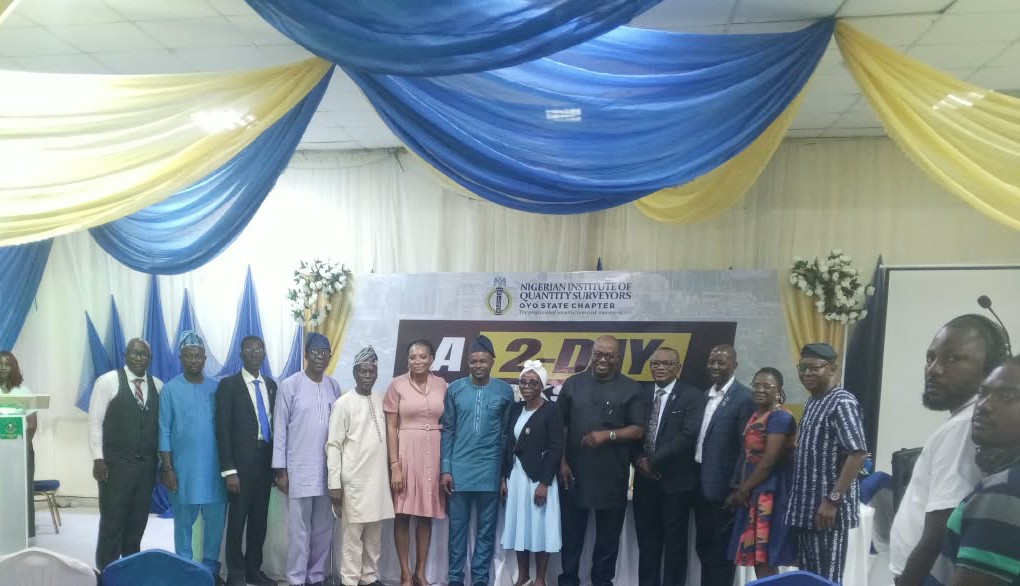
The call was made on Wednesday at a two-day workshop organised by the institute at the University of Ibadan Conference Hall, Ibadan, with the theme: “Reimagining Quantity Surveying: Delivering Greater Value in a New Economic Reality.”
The workshop, which commenced on Wednesday, October 7, and ends Thursday, October 8, 2026, brought together quantity surveyors and other professionals in the built environment to examine the impact of inflation, exchange-rate volatility, technology and changing client expectations on the profession.
Speaking as the Special Guest of Honour, Oyo State Commissioner for Public Works, Infrastructure and Transport, Hon. Abdulmojeed Olawale Mogbonjubola, said quantity surveying had moved beyond mere estimation of construction costs to ensuring value for money on projects and investments.
Mogbonjubola said the ability of quantity surveyors to provide accurate cost advice could improve productivity, promote dignity and stimulate economic activities.
He said: “Quantity Surveying is more than estimating, it is about giving value for money expended on projects and investments of an individual, groups, communities, societies, countries and the entire globe.”
The commissioner noted that the rapid urban expansion in Oyo State and increasing demand for housing, commercial facilities, transportation infrastructure, educational institutions, healthcare facilities and public spaces had made the role of quantity surveyors increasingly important.
According to him, the modern quantity surveyor must be “more than a cost adviser,” but must also become a problem-solver, cost planner, environmental steward and partner in development.
He urged NIQS to continue investing in mentorship, professional development, research, digital technology and continuous education to prepare younger professionals for emerging challenges.
Mogbonjubola specifically encouraged quantity surveyors to acquire proficiency in modern technologies and software, including QScard, PlanSwift, WinQS, QS Plus, Building Information Modelling (BIM) and other quantity surveying tools.
He also called for stronger engagement between the institute, government and other stakeholders, saying professional advice and innovative solutions from quantity surveyors would help government achieve better value for money in public projects.
Earlier, the Chairperson of NIQS Oyo State Chapter, Abass Adelayo, said the workshop was designed to help members adapt to the realities of inflation, exchange-rate fluctuations and increasing construction costs.
Adelayo said the profession could no longer remain focused solely on project costing, stressing the need for quantity surveyors to become value creators and strategic advisers.
She illustrated the impact of rising construction costs with the case of a three-bedroom duplex whose estimated construction cost was about N25 million in 2022 but had risen to about N89 million when reassessed at prevailing rates.
She said the situation demonstrated the need for quantity surveyors to understand economic realities and provide clients with solutions that respond to changing market conditions.
Adelayo also narrated a case involving a client who wanted to construct a greenhouse within a N50 million budget. Rather than simply costing the original design above the client’s budget, another quantity surveyor examined what the client actually wanted to achieve.
According to her, the QS developed a phased proposal involving two two-bedroom apartments costing about N40 million, using appropriate cost-management and bioengineering approaches, with a plan for income generation before proceeding to the second phase.
She said the example demonstrated how quantity surveyors could transition from merely answering the question of “how much will it cost?” to addressing the more important question of “what value can we create for the client?”
The chairperson urged participants to learn, unlearn and relearn, stressing that “business as usual” was no longer sufficient in the profession.
In her presentation, the guest lecturer, Dr Betty Oluwafunso Olojede, of the Department of Quantity Surveying, Obafemi Awolowo University, Ile-Ife, challenged professionals to justify the continued relevance of quantity surveyors in an era where digital applications can produce construction cost estimates within minutes.
She asked participants: “An app can estimate my building cost in few minutes. What additional value will you provide?”
Olojede said the answer lay in the ability of quantity surveyors to provide evidence-based advice, assess risks, compare alternatives, manage costs throughout a project’s life cycle and remain accountable for professional decisions.
She identified seven major areas for reimagining professional value, including whole-life value, digital delivery, currency and inflation exposure, sustainability, cost intelligence, service diversification, and people, independence and ethics.
According to her, traditional practices such as static and manual preparation of bills of quantities, purely reactive cost advice and fixed pricing without adequate mechanisms for inflation and currency risks could no longer adequately serve clients in a volatile economy.
She advocated the use of fluctuation and price-adjustment clauses, identification of foreign-exchange-exposed materials and equipment, and regular cost-risk dashboards to keep clients informed.
Olojede also warned that the advisory space would not remain vacant, noting that project managers, engineers, builders, in-house client cost teams and software platforms were increasingly providing services traditionally associated with quantity surveyors.
“Clients are not waiting for QS to catch up,” she stated.
She therefore urged quantity surveyors to embrace technology, including BIM and AI-powered tools, while maintaining professional responsibility for verifying quantities, rates, references, contract provisions and other information before issuing advice.
The lecturer further emphasised the importance of sustainability, saying professionals should distinguish between construction costs and carbon costs and consider whole-life costs, maintenance, operational performance and environmental impacts when advising clients.
She said diversification into services such as cost health checks, bid reviews, contract risk audits, claims preparation, lifecycle cost advice, PPP cost inputs and dispute-related services could create new opportunities for quantity surveying firms.
Olojede concluded that Nigeria’s infrastructure deficit and growing investment requirements represented an opportunity rather than merely a threat to the profession.
She said every infrastructure need ultimately involved questions of cost, value and risk, making the expertise of quantity surveyors more relevant if they were willing to adapt to the new economic environment.
Also speaking, the immediate past chairman of the NIQS Oyo State Chapter, Oluwade Kolawole, said the workshop was primarily designed for capacity building.
Kolawole said the construction industry was experiencing rapid technological and economic changes, making continuous professional development essential.
He said the rising prices of materials, labour and other construction inputs had made it necessary for quantity surveyors to develop new approaches that would enable clients to obtain value despite economic pressures.
He added that the workshop was intended to ensure that participants remained abreast of evolving technologies and challenges confronting the construction industry.