

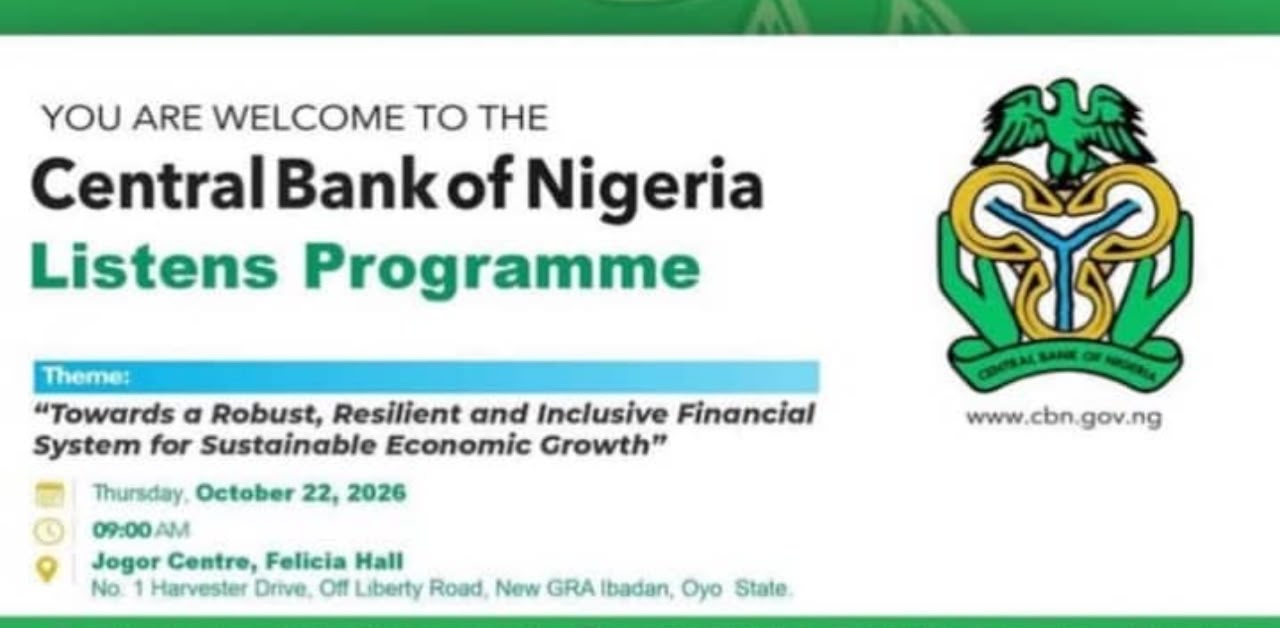
The Central Bank of Nigeria (CBN) has reiterated its commitment to ensuring monetary and financial system stability while fostering inclusive growth and macroeconomic resilience across the nation.
The apex bank made this disclosure on Thursday in Ibadan, during the “CBN Listens Programme,” with the theme, “Towards a Robust, Resilient and Inclusive Financial System for Sustainable Economic Growth.”

In his welcome address, CBN Governor, Mr. Olayemi Cardoso, represented by the Director, Stakeholder Engagement and Institutional Relations Department of the apex Bank, Mrs. Hakama Sidi Ali, noted that effective policy formulation and implementation depend heavily on continuous dialogue and constructive feedback from members of the public.
Sidi Ali highlighted key reforms spearheaded by the apex bank over the past 38 months aimed at restoring macroeconomic stability, enhancing market transparency and driving wealth creation to alleviate poverty.
According to her, the pragmatically designed interventions include the unification of foreign exchange rates, enhanced transparency in the FX market and the introduction of the B-Match System for forex trading.
She also outlined other landmark regulatory initiatives, including the successful recapitalisation of the banking sector to bolster resilience and global competitiveness; the launch of the Non-Resident Bank Verification Number (BVN) to seamlessly connect Nigerians in the diaspora to domestic banking services; and the unveiling of the Nigeria Payments System Vision 2028.
She added that, to address liquidity management and curb inflationary pressures, Sidi Ali noted that the central bank implemented a 75 per cent Cash Reserve Ratio (CRR) on non-Treasury Single Account (TSA) public sector deposits. Furthermore, in collaboration with the Financial Markets Dealers Association (FMDA), the apex bank introduced the Nigerian Overnight Financing Rate (NOFR) to serve as a transparent, market based reference rate for short-term funding in alignment with global best practices.
Reinforcing the bank’s stance on financial inclusion, Sidi-Alli emphasized that economic growth cannot be truly sustainable without extending financial opportunities to every segment of the society.
“Financial inclusion remains a critical pillar of national development because it expands economic opportunities, reduces poverty, supports entrepreneurship, and promotes shared prosperity,” she stated.
“We therefore continue to work closely with financial institutions, fintech companies, mobile money operators, development partners, and state governments to extend financial services to the underserved and unserved populations of Nigeria.”
She urged participants, comprising representatives of the Oyo state Government, traditional rulers, community leaders, financial institutions, market and trade associations, professional bodies, academia, civil society groups, youth corp members, students and media executives, to engage frankly and constructively to help shape future monetary policy interventions.