

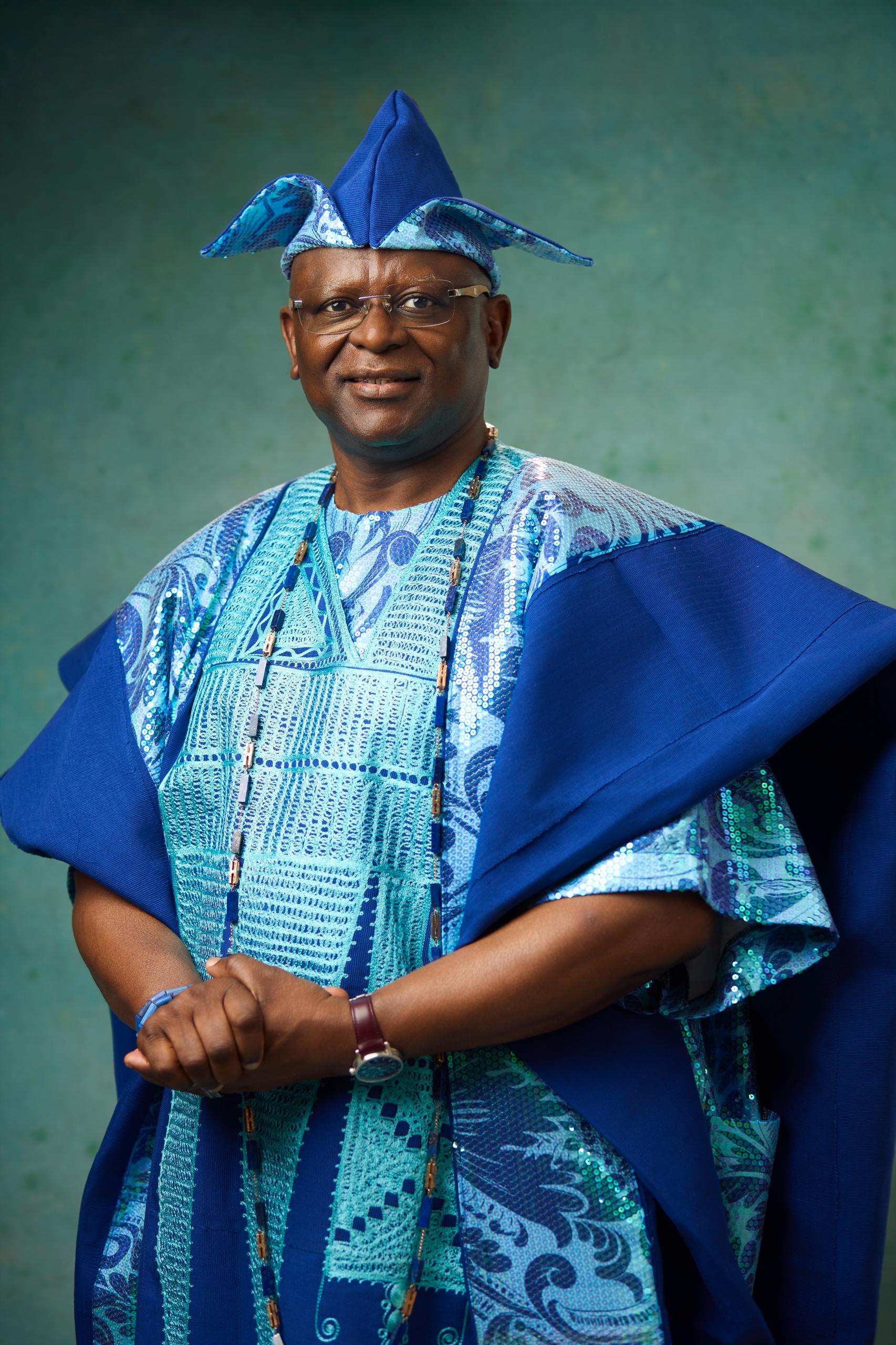
On Saturday, September 5, 2026, within the ancient Palace of the Alaafin of Oyo, a journey that began almost two centuries ago will come full circle.
His Imperial Majesty, Oba Abimbola Akeem Owoade I, Alaafin of Oyo, will formally install Oloye (Dr.) Adesola Kazeem Adeduntan — Founder and Chairman of Sequoia Holdings; Pro-Chancellor and Chairman of the Governing Council of Abiola Ajimobi Technical University; former Group Chief Executive Officer of FirstBank; and Apesinọla of Ibadanland — as the Balogun of Oyo.

On the eve of the installation, President Bola Ahmed Tinubu added the voice of the Presidency to the occasion, congratulating Adeduntan and describing his elevation as both an honour and a call to greater service.
The ceremony is expected to bring together an unusually distinguished gathering of traditional, public and business leadership. Expected guests include His Imperial Majesty, Oba (Senator) Rashidi Adewolu Ladoja, Arusa I, Olubadan of Ibadanland; members of the Olubadan-in-Council; members of the Oyo State traditional councils; eminent Royal Fathers from across Yorubaland; senior public officials; and leading captains of industry.
The financial-services sector is expected to be particularly strongly represented. It is the industry in which Adeduntan built much of his professional reputation and where, following almost a decade at the helm of FirstBank, he remains a colossus and one of the industry’s consequential institution builders.
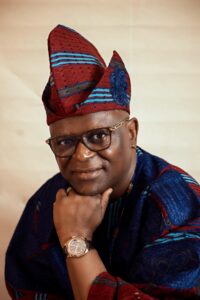
But for Adeduntan, the ceremony is much more than the conferment of another traditional title.
“It is a homecoming.”
A Journey Almost Two Centuries in the Making
Nearly two centuries ago, Adeduntan’s forebears left the old imperial capital of Oyo-Ile during the upheavals that transformed the old Oyo Empire and eventually settled in Ibadan. There, succeeding generations of the Oriolowo family put down roots.
Adeduntan was born in Ibadan on May 7, 1969. He was raised and educated in the city, and graduated from the University of Ibadan in 1992 as a Doctor of Veterinary Medicine.
His late father, Alhaji Sakariyau Adisa Adeduntan Oriolowo, ensured that the family’s ancestral memory was not lost. He taught his son the family’s history, its Oyo origins, the significance of Yoruba culture and the obligations embedded in the traditional family system.
Almost two centuries after the ancestral journey from Oyo to Ibadan, a descendant now returns to the source to assume one of Oyo’s historic offices.
Adeduntan is, therefore, Oyo by ancestry and Ibadan by birth and formation — identities he regards not as competing inheritances, but as branches of a shared historical continuum.
An Ancient Office for a Different Age
The Balogun belongs to the institutional heritage of the old Oyo Empire. Historically associated with military leadership, courage, strategy, loyalty to the Alaafin and defence of the realm, the office has survived long after the cavalry and territorial empire passed into history.
Among its distinguished modern holders were Chief Bode Thomas, the celebrated lawyer, nationalist and statesman, and Dr Victor Omololu Olunloyo, mathematician, engineer, statesman and former Governor of old Oyo State. Adeduntan now enters that distinguished succession.
But what does it mean to become Balogun in twenty-first-century Nigeria? For the incoming Balogun, while the battlefield has changed, the obligation to serve has not.
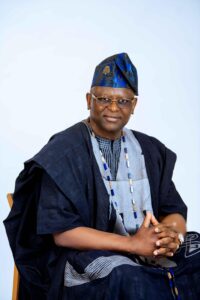
Today’s adversaries are poverty, unemployment, inadequate healthcare, educational disadvantage, insecurity, weak institutions and the absence of opportunity for too many young people. The modern instruments are education, enterprise, investment, innovation, institution-building and the capacity to mobilise people and resources. It is an interpretation particularly suited to Adeduntan’s own career.
From Veterinary Medicine to Institution-Building
Few Nigerian banking careers have followed a less conventional route. After qualifying as a veterinary surgeon, Adeduntan moved into banking and professional services, passing through Afribank, Arthur Andersen and KPMG. He qualified as a Chartered Accountant and obtained an MBA from Cranfield University as a Chevening Scholar.
At Citibank Nigeria, he rose to Senior Vice-President and Chief Financial Officer. In 2007, he joined the newly established Africa Finance Corporation as pioneer Chief Financial Officer and Business Manager. He helped construct the young institution’s financial, operational and technological architecture, and led the strategy through which AFC secured its maiden investment-grade international credit rating.
Then came the institution with which perhaps the defining chapter of his professional career would become associated: FirstBank.
The FirstBank Years
Adeduntan joined FirstBank in July 2014 as Executive Director and Group Chief Financial Officer. In January 2016, at 46, he became its Group Chief Executive Officer — the youngest ever to hold the office and, by his retirement in 2024, its longest-serving.
Over almost nine years at the helm, Adeduntan led one of the most consequential transformations in the Bank’s modern history.
Profit before tax rose from about ₦10 billion in 2015 to more than ₦300 billion by 2023. Customer accounts passed 40 million, digital banking users reached 23.2 million, and more than 90 per cent of customer-induced transactions migrated to digital channels, while FirstMonie developed into one of Africa’s largest bank-led agency banking networks.
But the deeper story of the FirstBank years was institutional renewal. The transformation encompassed asset quality and risk management, governance, technology, digital capability, talent development and management, financial inclusion and the modernisation of an institution founded in 1894.
It was this record that President Tinubu singled out in his September 4 message of congratulation, describing Adeduntan’s banking career as distinguished and his stewardship at FirstBank as a “far-reaching transformation of one of Nigeria’s oldest and most important financial institutions.”
One maxim became closely associated with his leadership style at FirstBank:
“Strategy without execution is hallucination.”
For Adeduntan, strategy mattered only when translated into outcomes. Another principle increasingly came to define his leadership philosophy: leadership is stewardship.
In that conception, a leader does not own the institution entrusted to him. He holds it temporarily in trust: to preserve what is valuable, reform what needs improvement, build what is missing, develop those who will come after him and, ultimately, leave the institution stronger than he found it. The continued progress of FirstBank after his retirement is, from that perspective, not separate from his legacy, but one of the tests of it.
The Power to Convene
Yet balance sheets and institutional metrics tell only part of Adeduntan’s story. One of his greatest strengths is less easily quantifiable: his convening power.
Over more than three decades across professional services, commercial banking, international development finance, boardrooms, enterprise, academia and philanthropy, Adeduntan has built relationships that cut across business, government, traditional institutions, international finance, academia and civil society. His strength lies in the ability to convene people, networks and capital.
That matters because development is rarely constrained by ideas alone. Often, the missing link is the ability to connect an idea to capital; a community to expertise; public purpose to private-sector execution; or institutions that would achieve more by working together.
For an ancient office seeking contemporary relevance, such convening power could prove particularly consequential. The Balogun of old mobilised men and means in defence of the realm. The modern Balogun may have no cavalry to summon, but the capacity to mobilise people, expertise, influence, networks and capital in the service of society remains a formidable instrument of leadership.
Another Chapter, Not Retirement
Adeduntan’s retirement from FirstBank in 2024 did not mark a retreat from institution-building. It opened another chapter.
Today, as Founder and Chairman of Sequoia Holdings, he is building and investing across strategic sectors of the Nigerian economy. Its public profile reflects interests spanning financial services, strategic minerals, professional services and other long-term investment platforms.
Its flagship minerals business, Sequoia Minerals & Metals, is developing district-scale positions across prospective mineral belts in Nigeria, spanning critical minerals, precious metals and industrial minerals. Its underlying thesis is that Nigeria should discover, develop and retain more of the value embedded in its mineral endowment at home.
There is also an unusual cultural dimension to the enterprise. Several mineral districts and provinces carry names drawn first from the histories of Ibadan and then Oyo — Oluyole, Oderinlo, Ibikunle, Ogunmola, Akere and Latosa from Ibadan’s historic tradition; and Ajagbo, Ofinran, Ojigi, Abiodun Adegoolu and Atiba Atobatele from Oyo’s royal and imperial heritage — with Oriolowo, his own family name, also anchoring a district. In that sense, even the map of the enterprise connects the future with history.
The President’s message took note of this new chapter too, recognising Adeduntan’s continuing contribution through enterprise and his investment in the nation’s solid-minerals sector.
Education as Nation-Building
Adeduntan’s post-banking chapter extends well beyond private enterprise. In 2025, Governor Seyi Makinde appointed him Pro-Chancellor and Chairman of the Governing Council of Abiola Ajimobi Technical University, Ibadan. His focus there has been on governance, institutional sustainability, academic excellence and closer alignment between technical education and the productive economy.
This responsibility, too, drew the President’s acknowledgement, cited in his congratulatory message as part of Adeduntan’s continuing contribution to national development.
The philosophy is consistent with his wider worldview: countries are ultimately transformed by the quality of the institutions they build and the people those institutions develop. For Adeduntan, science, technology, engineering and mathematics — STEM — are especially crucial to the future of Nigeria and Africa. In a world increasingly shaped by technology, artificial intelligence, advanced manufacturing, the energy transition and scientific innovation, he sees investment in STEM capabilities not simply as an educational priority, but as an economic and developmental imperative.
From Achievement to Service
Philanthropy provides another strand. Through the Adesola Adeduntan Foundation, modern Grade ‘A’ Primary Healthcare Centres are being developed within the palace complexes of the Olubadan of Ibadanland and the Alaafin of Oyo. Both facilities are already under development and are expected to open to the general public by the first quarter of 2027.
The significance lies not merely in constructing buildings. The intention is to create functioning community institutions capable of continuing to serve mothers, children, families and communities long after the ceremonies surrounding their benefaction have been forgotten.
Here again, the State House message offered explicit recognition, noting the Foundation’s investment in modern healthcare centres serving the communities of Oyo and Ibadan.
The Foundation’s work also extends substantially into education, especially STEM, which Adeduntan considers crucially important to the future competitiveness and prosperity of Nigeria and Africa. Its interventions are conceived around widening access to opportunity and building the human capacity required for the economies of tomorrow. The philosophy is straightforward: not merely to give, but to build capacity; not merely to relieve today’s need, but to enlarge tomorrow’s possibility.
Two Thrones, One History
There is another symmetry to Saturday’s installation. In May 2019, the late Olubadan of Ibadanland, Oba Saliu Akanmu Adetunji, conferred on Adeduntan the title of Apesinọla of Ibadanland. He will now simultaneously bear the titles of Apesinọla of Ibadanland and Balogun of Oyo.
The expected presence at Saturday’s ceremony of the current Olubadan, His Imperial Majesty, Oba (Senator) Rashidi Adewolu Ladoja, Arusa I, together with members of the Olubadan-in-Council, gives that symmetry added significance.
Far from being contradictory, the two honours tell something of the intertwined histories of Oyo and Ibadan. Oyo is Adeduntan’s ancestral source; Ibadan is the city of his birth, upbringing and formation. The installation therefore carries a significance beyond one man’s career. It is also a reminder of the migrations, relationships and shared histories through which modern Yorubaland emerged from the convulsions of the nineteenth century.

A Gathering of Traditional and Corporate Leadership
Saturday’s ceremony is expected to provide its own illustration of Adeduntan’s unusual ability to bridge different worlds and convene people across institutions, geographies and generations.
At the centre of the traditional delegation expected in Oyo is His Imperial Majesty, Oba (Senator) Rashidi Adewolu Ladoja, Arusa I, Olubadan of Ibadanland, accompanied by members of the Olubadan-in-Council — giving particular resonance to the installation of a man who already bears the title of Apesinọla of Ibadanland and now returns to his ancestral Oyo source as Balogun.
Members of the Oyo State traditional councils and eminent Royal Fathers from other parts of Yorubaland are also expected. Among them are the Owa Obokun of Ijesaland, Oba Adesuyi Haastrup Ajimoko III; the Oluwo of Iwoland, Oba Abdulrasheed Adewale Akanbi, Telu I; the Olowu of Owu Kingdom, Oba Professor Saka Matemilola; the Orangun of Oke-Ila, Oba Adedokun Abolarinwa; the Olugbon of Orile-Igbon, Oba Francis Olushola Alao; and HRM Oba Elias Omoloro Adedapo, Ijelu I, the Olota and Paramount Ruler of Otta Kingdom.
There will also be a significant Lagos traditional delegation accompanying Adeduntan on the journey to Oyo, adding another dimension to a ceremony already rich in the intersecting histories of Yorubaland. The delegation includes HRM Oba AbdulWasiu Omogbolahan Lawal, Abisogun II, Oniru of Iru Kingdom; HRM Oba Morufdeen Amodu-Tijani Oluwa, Amore III, Olu of Iwa and Apapa Kingdom; HRM Oba Kolawole AbdulLateef Lawal Olumegbon, Akinwon IV, Olumegbon of Aja Ile and Okun Aja; and HRM Oba Sulemom Adekunle Bamgbade, Edun Alaka III, Olofin of Isheri.
They will be joined by prominent Lagos chiefs, including His Highness Chief Ajibade Nosiru Ayeni, Eletu Odibo of Lagos, Head of the Akarigbere Royal Class of Chiefs and Traditional Prime Minister to the Oba of Lagos; His Highness Chief Adebola Alabi Dosunmu, Olorogun Adodo of Lagos and Akinsiku Alaworo Eyo; His Highness Chief Ismail Oladehinde Folaji, Olorogun Ide of Lagos; His Highness Bolaji Oluwa Onisemo, Onisemo of Lagos; Chief Ayodele Oyekan, Bajulaiye of Lagos; and Chief Adesoji Ajayi Bembe, Baba Oloye Obanikoro of Lagos.
The presence of this Lagos delegation is particularly noteworthy. The installation is fundamentally a story of Oyo and Ibadan, but the relationships surrounding Adeduntan extend well beyond those two ancient cities. The journey to Oyo will itself bring together important strands of contemporary Yoruba traditional leadership — from Ibadan, Ijesaland, Iwo, Owu, Oke-Ila, Orile-Igbon, Otta and Lagos — around the throne of the Alaafin.
Senior public officials and leading figures from corporate Nigeria are also expected, and the financial-services industry will have a particularly strong presence. That would be fitting. For although Adeduntan’s interests today range from strategic minerals and professional services to education and philanthropy, banking remains the arena in which he first became nationally and internationally recognised as an institution-builder. His years at FirstBank placed him at the centre of Nigerian and African finance, and he remains a colossus in the financial-services industry, deeply connected to an ecosystem in which his influence, relationships and record of transformation continue to resonate.
The gathering therefore represents considerably more than an impressive guest list. It is convening power made visible — the capacity, accumulated over decades, to bring together people, networks and capital across traditional institutions, government, finance, enterprise and civil society. It captures the unusual intersection at the heart of the incoming Balogun’s life: tradition and modern enterprise; Ibadan and Oyo; heritage and institution-building; public purpose and private capital; history and the future.
A Presidential Charge
The State House message released on September 4 provides perhaps the clearest external expression of what Saturday’s honour is intended to demand of its new holder. President Tinubu urged the incoming Balogun to carry into the ancient office the qualities that had marked his professional life:
“As you assume this historic responsibility, I urge you to bring to the service of the Alaafin, the Oyo Kingdom and its people, the same discipline, strategic foresight and commitment to excellence that have distinguished your professional and public life.”
He framed the installation not as a culmination, but as a beginning —
“Your installation is both an honour and a call to greater service.”
— and expressed confidence that Adeduntan would continue to deploy his experience, influence and resources towards promoting peace, opportunity, development and the preservation of Nigeria’s rich cultural heritage.
Those words are particularly apposite to a man whose post-banking life has increasingly been organised around precisely those resources: experience accumulated across institutions, influence built across sectors, networks capable of convening people and capital, and an expanding commitment to deploy them towards enterprise and public purpose.
“I Come to Serve”
There is an unusual symmetry between the President’s charge and Adeduntan’s own intended response. For all the history, personalities and ceremony surrounding Saturday, his message is remarkably simple. In his prepared acceptance address, he interprets the office through the same philosophy that has followed him through banking, enterprise, education and philanthropy:
“This office existed long before Adesola Adeduntan. By the grace of Almighty Allah, it will endure long after me. My responsibility is therefore not to possess it, but to serve through it.”
And to the people of Oyo, an even shorter pledge:
“I come not merely to bear your title. I come to serve.”
That may ultimately be the most useful way to understand Saturday’s ceremony. The warrior’s battlefield has disappeared. The cavalry belongs to history. But the underlying questions remain familiar: What does leadership demand? What does privilege owe society? And what should a person do with the relationships, knowledge, influence and capital accumulated over a lifetime?
For Adeduntan, the answer is stewardship. And perhaps that is where the ancient office and the modern institution-builder most naturally meet — in the capacity to convene people, mobilise networks, attract capital and turn influence towards service.
Nearly two centuries after his forebears journeyed from Oyo-Ile to Ibadan, their descendant returns — not to reclaim something history left behind, but to accept responsibility for what his generation must build.
From Oyo-Ile to Ibadan — and home again.