
Lekan Yusuf, Ibadan
A group of over 300 independent National Identification Number (NIN) enrolment agents across Nigeria have raised alarm over unpaid commissions, mounting loan obligations, and what they describe as “indiscriminate deductions” from their bank accounts, calling for urgent government intervention.

The agents, who operated under the National Identity Management Commission (NIMC), said they were engaged in 2021 through File Solutions Limited, an accredited Frontend Enrolment Partner, to support the Federal Government’s mass enrolment drive.
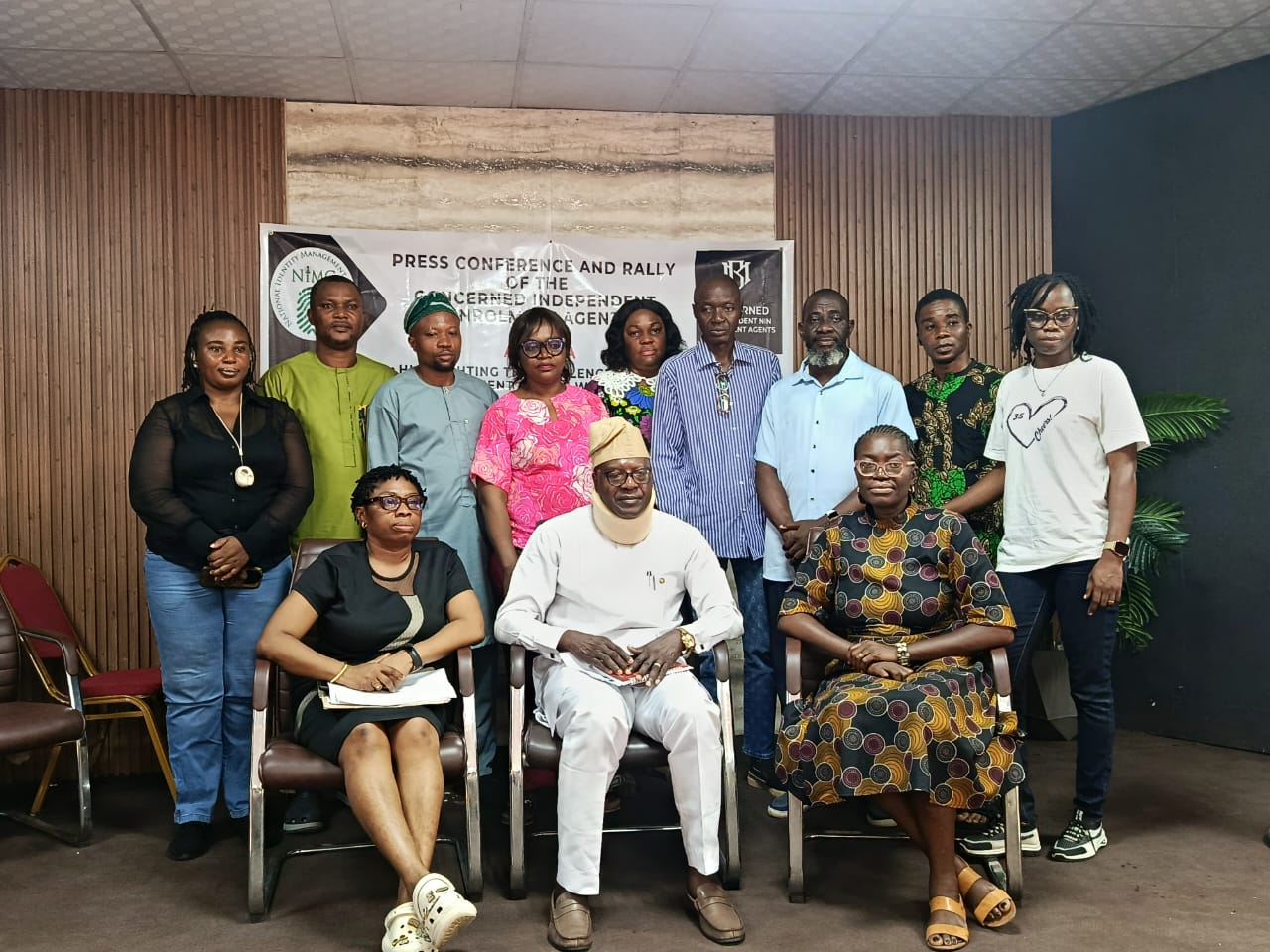
Speaking on behalf of the group, the Coordinator, Paul Taiwo Odebunmi, alongside Co-ordinator, Mrs. Ebele Ataka, and Member of the Organizing Committee, Mrs. Bunmi Omololam, explained that under the arrangement, each agent was to receive a commission of $1 per successful enrolment, payable monthly.
To facilitate the acquisition of enrolment devices and operational costs, the agents secured loans of over ₦4.1 million each from NIRSAL Microfinance Bank (NIRSAL MFB) under the AGSMEIS scheme, with repayment tied to their expected commissions.
However, the agents alleged that after initial payments in April and May 2021, NIMC stopped paying commissions for several months, leading to severe financial hardship. Although some backlog payments were later made in 2022, they said consistent payments never resumed.
According to the group, the situation worsened when NIRSAL MFB, with support from the Central Bank of Nigeria (CBN), allegedly began recovering loan repayments through the Global Standing Instruction (GSI) mechanism. They claimed this resulted in funds being deducted not only from their accounts but also from those of family members, referees, and business associates.
Describing the development as distressing, Odebunmi said several agents recorded withdrawals running into huge sums, sometimes exceeding ₦1 million, from personal accounts—triggering family disputes and financial instability.
Their predicament deepened in October 2023 when NIMC reportedly withdrew their enrolment licences following a revalidation exercise. Mrs. Ataka noted that the licences and equipment, which were financed through the loans, became unusable, effectively cutting off their source of income.
The agents further alleged that despite a public promise by NIMC in March 2024—following media intervention—to settle outstanding payments, only partial payments were made later in the year, leaving significant debts unpaid. Mrs. Omololam also questioned the transparency of the payments, citing discrepancies in exchange rates and enrolment data.
The group added that efforts to engage NIRSAL MFB for loan restructuring, including a physical meeting in August 2025, have not yielded meaningful results. They also lamented the bank’s refusal to provide account statements, making it difficult for them to properly assess their financial standing.
In a formal appeal jointly signed by Paul Taiwo Odebunmi, Mrs. Ebele Ataka, and Mrs. Bunmi Omololam, the agents called for:
Immediate suspension of GSI-related deductions.
A joint stakeholders’ meeting involving NIMC, NIRSAL MFB, and File Solutions Limited.
Removal of all liens placed on their Bank Verification Numbers (BVN) and businesses.
Cancellation or conversion of the loans into grants due to alleged contractual breaches.
They argued that the challenges they face contradict the objectives of the AGSMEIS scheme, which is designed to support small and medium enterprises and promote economic development.
The agents warned that the prolonged crisis has led to severe socio-economic consequences, including business collapse, health challenges, and, in some cases, loss of lives.
They appealed to the Federal Government and relevant stakeholders to urgently intervene and provide a lasting resolution to the matter.