
Lekan Yusuf, Ibadan
A former member of the House of Representatives, Shina Abiola Peller, has called on Nigerian politicians to embrace developmental politics and shun divisive tendencies capable of undermining national growth.

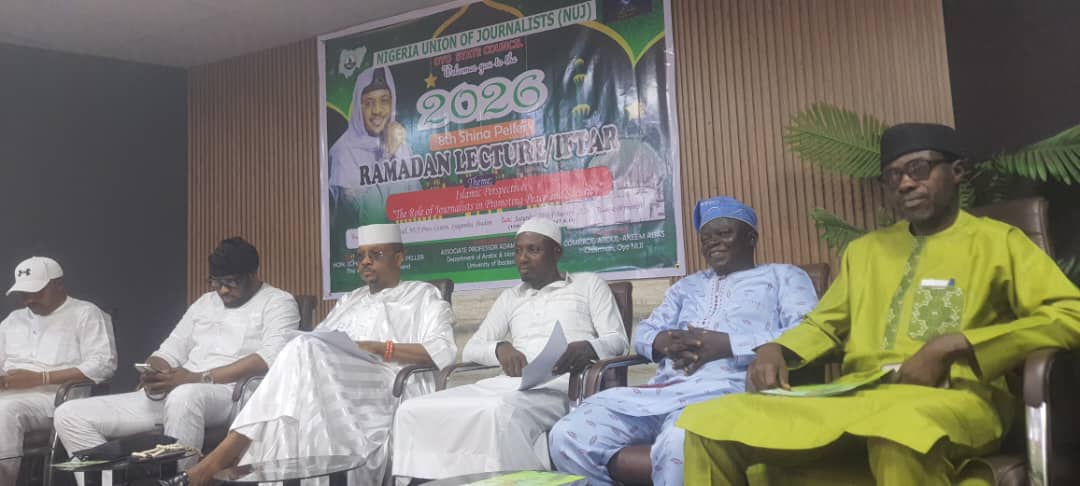
Peller made the appeal while addressing journalists at the 8th NUJ/Shina Peller Ramadan Lecture and Iftar held at the NUJ Press Centre Iyaganku, inside the Dapo Aderogba Conference Hall, Ibadan.
He urged political actors across party lines to prioritise love, unity and collective progress over rivalry and bitterness.
According to him, politicians must move away from what he described as “pull-him-down politics” and instead appreciate good governance wherever it exists, regardless of party affiliation.
“People always ask me why I promote the work of my successor, Honourable Najeemdeen Oyedeji, also known as Oshine, representing Iseyin, Itesiwaju, Iwajowa and Kajola Federal Constituency. I tell them, why won’t I promote him? I always pray that whoever comes after me should succeed and even do more than I did,” he said.
He stressed that politics should not be driven by hatred or desperation but by genuine concern for development and service to the people.
“Politicians need to love one another. Let us leave politics of agony and embrace love among ourselves in order to make our country great,” he added.
On the role of the media in the era of digital and citizen journalism, Peller charged journalists to uphold truth and professionalism, especially amid rising misinformation online.
“In this era where anybody can post anything online, journalists must see themselves as prophets of truth. Before publishing any story, especially one meant to tarnish someone’s image, there must be proper verification and investigation,” he said.
Citing the Qur’an, particularly Surah Al-Hujurat (49:6), which admonishes believers to verify information before spreading it, Peller reminded media practitioners that their work carries moral and spiritual implications.
He referenced a recent social media report alleging a killing at Quilox, clarifying that while an incident reportedly occurred at a club in the United States bearing a similar name, it was not connected to his brand, which he noted is trademarked. He described the publication as an attempt to damage the reputation of his business.
“Journalists must understand that their actions can either build or burn a nation, a business or an individual. If you cannot promote a business, at least do not publish unverified information that can harm it,” he cautioned.
Addressing agitation from some groups in Oke-Ogun demanding the governorship of Oyo State, Peller acknowledged that the zone, which comprises 10 local governments and a significant landmass of the state, has been marginalised and deserves fair consideration.
However, he advocated a gradual approach, suggesting that the Oyo North Senatorial District—comprising Oke-Ogun and Ogbomosho—should first ensure equitable representation at the senatorial level through a rotational arrangement.
“For Oke-Ogun to become governor is important and desirable. We have competent individuals who can occupy that office. But such ambition must be strategic and must also have the support of Ibadan, which plays a major role in Oyo politics,” he said.
In his welcome address at the Dapo Aderogba Conference Hall, the Chairman of the Nigeria Union of Journalists (NUJ), Oyo State Council, Akeem Abas, described the Ramadan lecture as timely, given the nation’s need for moral rebirth, ethical leadership and responsible communication.
Abas said Ramadan teaches sacrifice, compassion, discipline and justice, values that should guide both leadership and journalism practice.
“As journalists, Ramadan reinforces our obligation to uphold truth, accuracy, fairness and integrity while discharging our constitutional mandate,” he said.
He commended Peller for sustaining the annual Ramadan lecture and Iftar hosted at the NUJ Press Centre, noting that the initiative has strengthened collaboration between the media, religious scholars and political leaders in Oyo State.
Abas also highlighted recent efforts by the NUJ Oyo State Council since assuming office in December 2025, including welfare initiatives, capacity-building programmes and digital training aimed at repositioning journalism practice in the state.
The event drew journalists, Islamic scholars, political stakeholders and members of the Muslim community, who later observed Iftar together and offered prayers for peace, unity and development in Oyo State and Nigeria.