
Lekan Yusuf, Ibadan
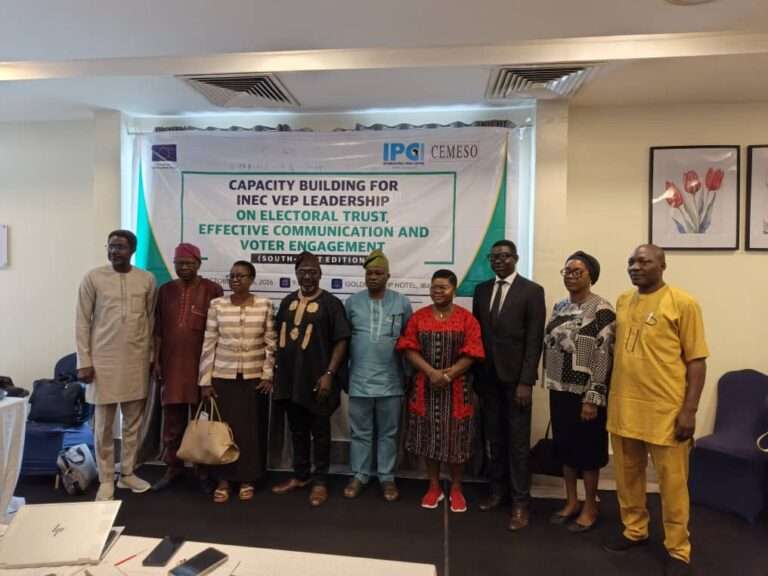
The International Press Centre (IPC), in collaboration with the Centre for Media and Society (CEMESO), has organised a two-day capacity-building programme for the Independent National Electoral Commission’s (INEC) Voter Education and Publicity (VEP) leadership to strengthen electoral communication, promote public trust and tackle misinformation ahead of the 2027 general elections.

The training, themed “Capacity Building for VEP Leadership on Electoral Trust, Effective Communication, Legal Literacy and Voter Engagement,” is holding at Golden Tulip Hotel, Ibadan, Oyo State, from October 15 to 16, 2026.
The programme, supported by the European Union under its Support to Democratic Governance in Nigeria (EU-SDGN) programme, is designed to equip VEP officers with the knowledge and practical skills required to communicate electoral information accurately, respond to public concerns and counter false narratives capable of undermining confidence in the electoral process.
Speaking with journalists at the programme, INEC Deputy Director of Information and Publicity, Wilfred Ifogah, described the training as essential to strengthening the Commission’s voter and civic education mandate.
Ifogah explained that electoral officials must understand what to communicate, when to communicate it and how to deliver accurate information to different categories of voters and stakeholders.
He said the capacity-building initiative would help officers improve their understanding of electoral laws, procedures and innovations while ensuring that the public received reliable information ahead of the forthcoming elections.
According to him, the media space was already saturated with information, some originating from INEC and others from sources seeking to mislead the public or discredit the Commission and the electoral process.
He noted that equipping VEP officers to distinguish verified information from false claims would enable them to respond more effectively to emerging controversies and help prevent misinformation from escalating into electoral crises.
Ifogah clarified that the programme was part of a nationwide capacity-building exercise designed to strengthen the skills of INEC personnel across the country’s geopolitical zones.
On the growing threat of artificial intelligence-generated content and deepfakes, he urged journalists and members of the public to verify information before sharing it.
“Verify before you amplify,” he advised, encouraging Nigerians to consult INEC’s official communication channels or contact designated communication officers to authenticate information concerning the electoral process.
He acknowledged that artificial intelligence could be useful but warned that its unethical application could produce fabricated results, misleading images and false statements capable of deceiving voters.
Ifogah commended IPC and CEMESO for supporting the Commission’s efforts to improve communication, media engagement and the dissemination of accurate electoral information.
He added that partnerships with organisations possessing relevant expertise were important because INEC could not address every communication challenge alone, given the resources required to engage all categories of stakeholders.
Earlier, the Executive Director of IPC, Mr. Lanre Arogundade, said electoral trust was shaped not only on election day but also by the quality, timing and credibility of information available to citizens in the months preceding the polls.
Arogundade warned that false claims could spread faster than official corrections, while AI-generated media could be used to fabricate electoral results, statements and scandals within minutes.
He said the training would expose participants to crisis and rapid-response communication, media relations, legal literacy, misinformation risk mapping, conflict-sensitive communication and inclusive voter engagement.
According to him, participants would also take part in practical simulations involving hostile press questions, viral rumours and election-day disputes, while developing plans to share the knowledge acquired with colleagues in their respective states.
Also speaking, the Executive Director of CEMESO, Dr. Akin Akingbulu, urged VEP officers to prioritise clarity, promptness and efficiency in communicating with Nigerians.
Akingbulu said the credibility of electoral information depended on the Commission’s ability to provide timely explanations, clarify legal provisions and communicate consistently across its offices.
He explained that the training would go beyond classroom discussions to practical exercises aimed at strengthening participants’ ability to respond to emerging electoral communication challenges.
Akingbulu further urged participants to cascade the knowledge gained to other INEC personnel at state and local government levels to ensure that voters received consistent and accurate information regardless of their location.
He said the regional initiative would continue in Jos, Enugu and Kano, extending the capacity-building exercise to other geopolitical zones ahead of the 2027 general elections.
The initiative forms part of efforts under the EU-SDGN programme’s Component 4, Support to Media, jointly implemented by IPC and CEMESO, to strengthen professional communication, promote informed civic participation and support credible electoral processes in Nigeria.